
Quick Summary
Commercial carpet maintenance is an ongoing routine of daily and weekly vacuuming, prompt spill treatment, and scheduled professional cleaning that keeps soil from settling deep into office carpet. Following a written plan with set intervals by zone catches wear early and extends the life of the carpet.
- Vacuum entrances, hallways and break rooms daily, since most soil enters through high-traffic doorways.
- Use a commercial-grade vacuum with a HEPA filter and make slow, overlapping passes in both directions.
- Blot spills immediately with a clean white cloth and never rub, because rubbing pushes the stain deeper.
- Schedule professional cleaning every 3 to 6 months in entrances and break rooms, and every 12 months in private offices.
- Use hot-water extraction once or twice a year, with encapsulation or bonnet cleaning in between to keep appearance up.
Table of Contents
- Why Office Carpet Needs a Structured Maintenance Plan
- Daily and Weekly Vacuuming: The Foundation of Commercial Carpet Maintenance
- Office Carpet Cleaning Schedule by Zone
- Commercial Carpet Cleaning Methods and When to Use Each
- Commercial Carpet Stain Removal: Acting Fast on Spills
- Troubleshooting Recurring Stains, Odors and Worn Spots
- Commercial Carpet Cleaning Cost and Budgeting for Maintenance
- Professional vs. In-House Maintenance: Who Does What
- Measuring Maintenance Results and Scheduling Your Next Service
- Frequently Asked Questions
Why Office Carpet Needs a Structured Maintenance Plan
Last Updated: November 21, 2026
Office carpet takes more abuse than most people realize. Rolling chairs, foot traffic, and tracked-in grit grind dirt into the fibers every day, and the damage builds quietly until a worn path or a permanent stain shows up. A structured maintenance plan, with set tasks at set intervals, catches that wear early. It also costs less than waiting for the carpet to fail and replacing it.
Commercial carpet maintenance is the ongoing routine of vacuuming, spot treating, and periodically deep cleaning a carpet so that soil never gets the chance to settle deep into the pile. A plan turns that routine into a checklist that someone is responsible for, rather than something everyone assumes is handled.
Office carpet is also unusually hard to judge by eye. Surface dirt is visible, but the abrasive grit beneath the surface is not, and that grit is what breaks down fibers over time. Regular vacuuming and scheduled professional cleaning remove what the eye misses. Many facilities teams find that a written plan makes budgets easier to defend, because the work is predictable instead of reactive.
Daily and Weekly Vacuuming: The Foundation of Commercial Carpet Maintenance
Consistent vacuuming is one of the most important things any office can do for its carpet. Daily vacuuming in entrances, hallways, and around desks removes the grit before it works into the backing. Weekly vacuuming covers the rest of the floor, including under desks and along the edges where dirt collects.
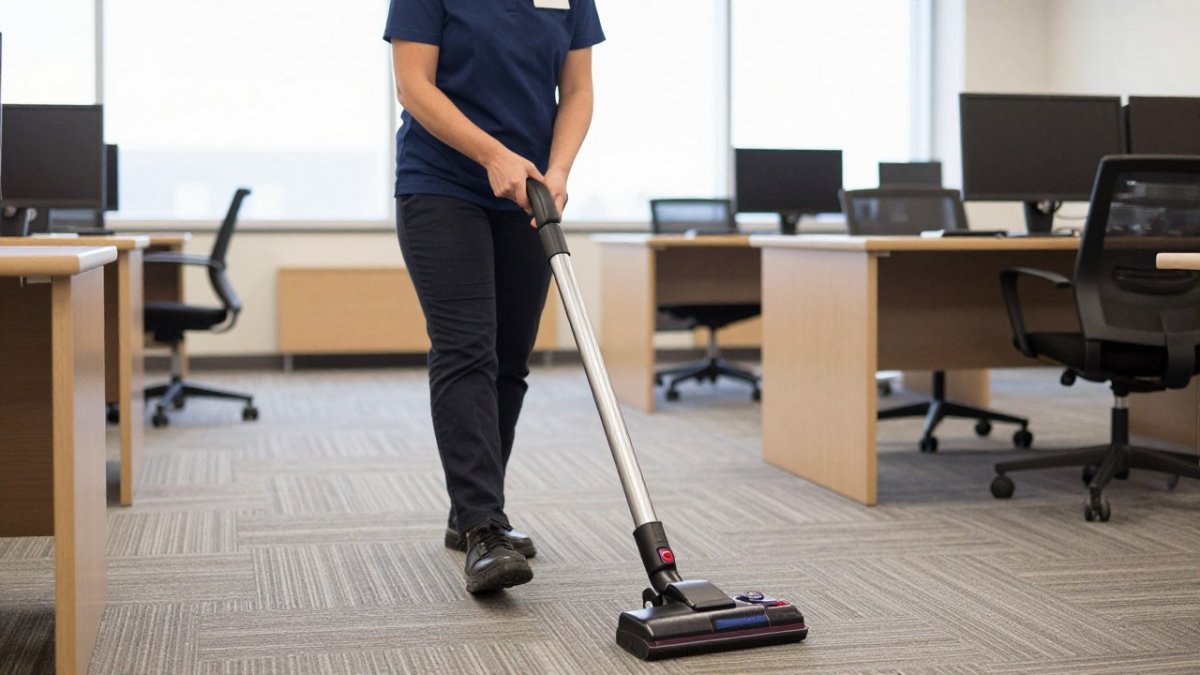
Follow these steps for each vacuuming pass:
- Use a commercial-grade vacuum, ideally one with a HEPA filter, which captures fine particles that standard units can push back into the air.
- Make slow, overlapping passes in one direction, then a second pass across the grain.
- Pay extra attention to entryways, where most soil enters the building.
- Empty or replace the bag or canister before it is full, since a full unit loses suction quickly.
- Check the brush roll weekly for hair and debris that can reduce agitation.
Many facilities teams underestimate how much grit a single high-traffic doorway collects in one day.
Office Carpet Cleaning Schedule by Zone
Not every area of an office needs the same attention. A practical approach is to divide the space into zones based on traffic and use, then assign a cleaning interval to each.
| Zone | Traffic Level | Vacuuming | Spot Treatment | Professional Cleaning |
|---|---|---|---|---|
| Entrances and lobbies | Very high | Daily | Same day | Every 3 to 6 months |
| Main corridors | High | Daily | As needed | Every 6 months |
| Open workstations | Moderate | 2 to 3 times weekly | As needed | Every 6 to 12 months |
| Private offices | Low | Weekly | As needed | Every 12 months |
| Break rooms and kitchens | High (spill risk) | Daily | Same day | Every 3 to 6 months |
Adjust these intervals for your own building. A space with pets, food service, or heavy foot traffic from visitors will need more frequent attention. Writing the schedule down and posting it where the cleaning crew can see it prevents the gaps that appear when responsibility is unclear.
Commercial Carpet Cleaning Methods and When to Use Each
Professional cleaning methods differ in moisture level, drying time, soil removal depth, and how much the office has to shut down while the carpet dries. The right choice depends on the carpet construction, the soil level, and how much downtime the space can absorb. Most facility managers end up using more than one method across a year rather than picking a single favorite.
Hot-water extraction
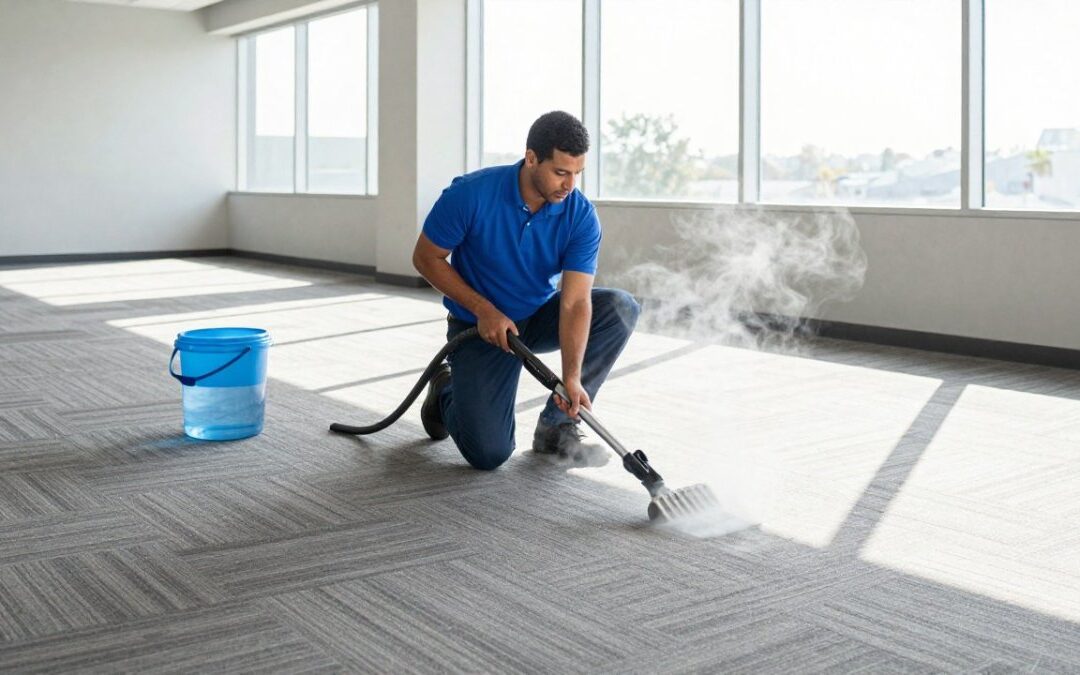
Hot-water extraction, often called steam cleaning even though it uses hot water rather than steam, injects a heated cleaning solution into the pile under pressure and immediately extracts it along with suspended soil. Offices that want this method done by a crew can book truck-mount extraction carpet cleaning with trained technicians.
- Drying time: typically 4 to 12 hours depending on humidity, airflow, and pile density.
- Disruption: high. Furniture usually has to be moved, and the area is out of service until dry.
- Best for: heavily soiled carpet, cut-pile and loop-pile nylon or polyester, and any area that has gone more than a year without restorative cleaning.
- Watch out: if the technician moves the wand too fast or uses too little solution, the carpet is left damp and soil is redistributed rather than removed; ask how they verify extraction and drying.
Low-moisture encapsulation
Encapsulation applies a specialized polymer solution that surrounds soil particles and crystallizes as it dries. The crystallized soil is then removed by vacuuming, usually the next day.
- Best for: interim cleaning in open workstations, meeting rooms, and areas that cannot be taken out of service, as well as low-pile and tight-loop commercial carpet where water penetration is a concern.
- Watch out: encapsulation is a maintenance tool, not a substitute for extraction; used alone for years, it can leave a residue layer that dulls the carpet and attracts soil.
Bonnet cleaning
Bonnet cleaning uses a rotary machine with an absorbent pad to lift soil from the surface of the pile. It is fast and inexpensive but works mainly on the top third of the carpet.
- Drying time: under 1 hour.
- Disruption: very low.
- Best for: quick appearance refresh in lobbies and corridors between deeper cleanings.
- Watch out: bonnet cleaning does not reach the backing, so it should not be the only method used in high-traffic entries where grit works its way down.
Shampooing
Shampooing applies a foaming detergent that is agitated into the pile and then removed, traditionally with a wet vacuum. It cleans well on surface soil but leaves more residue than extraction if the rinse step is skipped.
- Drying time: 6 to 12 hours.
- Disruption: moderate to high.
- Best for: older or delicate carpet where high-pressure extraction is not advisable.
- Watch out: residue left by shampoo is sticky and re-soils quickly; confirm that a rinse or acid-neutralizing step is included.
Dry or absorbent-powder cleaning
Dry cleaning compounds are spread into the pile, agitated, and vacuumed out. Moisture is minimal, so there is essentially no drying time.
- Drying time: none.
- Disruption: very low.
- Best for: occupied spaces with sensitive equipment, or buildings where humidity control is a problem.
- Watch out: dry methods remove surface soil well but are weak on oily or deeply embedded soil, so they work best as part of a rotation.
Choosing a method by carpet and conditions
A practical way to decide is to match the method to the carpet construction and the operating conditions rather than to a single “best” method.
| Carpet type or condition | First choice | Interim choice |
|---|---|---|
| Tight-loop commercial carpet, moderate soil | Hot-water extraction | Encapsulation |
| Cut-pile nylon, heavy soil | Hot-water extraction | Bonnet in high-visibility zones |
| Glued-down carpet tile | Encapsulation or low-moisture | Dry powder |
| Wool or delicate fiber | Low-moisture or shampoo with careful rinse | Dry powder |
| High-humidity building | Encapsulation or dry methods | Bonnet |
| Space that cannot close | Encapsulation | Dry powder |
A common pattern in offices is to run hot-water extraction once or twice a year on a scheduled basis and use encapsulation or bonnet cleaning in between to keep appearance up. Neither interim method replaces regular vacuuming, and no method compensates for a vacuuming program that has lapsed.
Commercial Carpet Stain Removal: Acting Fast on Spills
Spills on office carpet need attention the same day. The longer a liquid sits, the deeper it travels into the backing, and the harder it is to remove completely.
Follow this order when a spill happens:
- Blot the liquid immediately with a clean white cloth. Never rub, because rubbing pushes the stain deeper. For set-in stains, see how to remove deep carpet stains without chemicals.
- Work from the outside of the stain toward the center to prevent spreading.
- Apply a neutral detergent or a dedicated spot cleaner, following the product label.
- Blot again with a dry cloth to lift the stain and the cleaner.
- Rinse lightly with clean water, then blot dry.
Keep a spot kit with a neutral detergent, white cloths, and a small spray bottle at the front desk and in the break room. Test any cleaner on an inconspicuous area first, especially on wool or delicate fibers.
Troubleshooting Recurring Stains, Odors and Worn Spots
Some problems come back no matter how often the carpet is cleaned. The cause is usually something other than the cleaning itself.
Recurring stains often come from residue left by cleaning solution that was not rinsed out. The stain reappears as the carpet dries and the residue wicks soil back to the surface. A thorough rinse during extraction usually fixes this.
Persistent odors are commonly caused by moisture trapped in the backing or by soil that has never been fully removed. Improving ventilation, drying the carpet completely, and scheduling a deep clean often resolve the smell. A lingering odor that returns quickly suggests the problem is deeper in the padding and may need professional attention.
Worn spots appear in high-traffic paths where fibers have broken down from abrasion. Vacuuming and cleaning will not reverse this. Moving the carpet to a less-used area, or planning for replacement of that section, is the realistic fix.
Brown patches that appear after cleaning sometimes come from a chemical reaction between the detergent and soil. Ask your cleaner whether a neutralizing rinse is part of the process.
Commercial Carpet Cleaning Cost and Budgeting for Maintenance
Office carpet cleaning costs depend on several factors, and a single per-square-foot number rarely reflects a real building. The more useful approach is to understand what drives the price and how to build a budget that holds up across a multi-year cycle. Actual figures vary by market, so treat any per-square-foot number as a starting point for a quote, not a budget line.
What drives the cost
- Square footage and layout. Open floor plates are cheaper per square foot than offices broken up by cubicles, because setup and furniture moving take time.
- Method. Hot-water extraction generally costs more per square foot than encapsulation or bonnet cleaning because it takes longer and uses more equipment and solution.
- Soil level and condition. Carpet that has gone years without cleaning needs more passes, more solution, and sometimes a second visit.
- Frequency and scheduling. After-hours or weekend work usually carries a premium; bundling multiple zones into one visit reduces the per-visit cost.
- Access and furniture. Whether the vendor moves furniture, and whether elevators or stairs are involved, affects labor time.
- Add-ons. Stain protection, odor treatment, and spot-treatment training for in-house staff are usually priced separately.
Building a maintenance budget
Separate the budget into three buckets so the numbers are defensible when someone asks why carpet care is on the spreadsheet.
- Recurring in-house costs. Vacuum equipment, bags and filters, spot kits, and staff time. These are predictable and small relative to replacement.
- Scheduled professional cleaning. Build this from the zone schedule, entrances and break rooms more often, private offices less, and price it as an annual contract rather than a series of one-off visits. Recurring service agreements can help lock in the calendar, and pricing should be confirmed with the provider.
- Contingency. Set aside a modest reserve for spills, odor problems, and one-off restorative work. Some facilities choose to set aside a modest reserve for unplanned cleaning needs.
Lifecycle value
Carpet is one of the larger line items in an office refresh, and replacement is driven as much by appearance and soil load as by physical wear. A consistent maintenance program that removes abrasive grit and treats spills promptly keeps carpet in service longer, which pushes replacement out and spreads the capital cost over more years. The comparison that matters is not “cleaning versus no cleaning” but “cleaning versus earlier replacement plus the disruption of a flooring project.”
Getting a comparable quote
When you request estimates, ask each vendor to price the same scope so the numbers can be compared: square footage by zone, method per zone, frequency, furniture handling, drying and re-entry expectations, and what is excluded. A quote that lists only a total is hard to compare and easy to inflate later. You can request an estimate from 5 Stones Carpet Cleaning through our website, and ask for the scope breakdown in writing.
Professional vs. In-House Maintenance: Who Does What
Some maintenance tasks belong to your own staff or custodial team, and others are better handled by a professional. A reasonable split looks like this:
- In-house: Daily and weekly vacuuming, spot treatment of fresh spills, emptying equipment, and checking for worn spots.
- Professional: Periodic extraction cleaning, deep stain removal, odor treatment, and any cleaning that requires specialized equipment or chemicals.
If you handle daily tasks in-house, make sure the people doing them have proper equipment and training. A professional cleaning service can also train your staff on spot treatment. You can learn more about 5 Stones Carpet Cleaning’s services on our website.
Measuring Maintenance Results and Scheduling Your Next Service
A maintenance plan should show results you can see. Track a few simple measures: how often spills are reported, whether recurring stains appear, how quickly worn spots develop, and whether odors are a complaint. Walk the building once a month and note any changes.
Use those notes to adjust the schedule. If a zone keeps needing spot work between cleanings, move its professional service up. If the carpet looks clean for longer than expected, you may be able to extend the interval.
Schedule your next professional cleaning before the current one ends, and put it on the calendar with a named owner. You can book online through our website, and a free estimate is available for offices that want to review their options before committing. To compare the full range of options, browse our cleaning services.
Frequently Asked Questions
What is the going rate for commercial carpet cleaning?
Commercial carpet cleaning pricing depends on square footage, carpet condition, traffic level, the cleaning method chosen and how often the service is scheduled. Office buildings billed on a recurring contract often pay less per square foot than one-time jobs. Because rates vary, the most reliable approach is to request written estimates from several providers, compare what each includes, and check current pricing and free estimates on the 5 Stones Carpet Cleaning website.
How often should office carpets be professionally cleaned?
Most office carpets benefit from professional cleaning every six to twelve months, with high-traffic lobbies, entryways and corridors often needing attention more frequently. Offices with heavy foot traffic, food service areas or pets on site may need quarterly service. Daily vacuuming and prompt spot treatment between professional visits extend the interval and help the carpet keep its appearance longer.
What is the best way to remove stains from commercial carpet?
Blot liquid spills immediately with a clean white cloth, working from the outside of the stain inward so it does not spread. Apply a suitable spot cleaner, let it dwell briefly, then blot again and rinse lightly with clean water. Rub gently rather than scrubbing, since aggressive scrubbing can damage fibers and leave a visible ring. Always test the product on a hidden area first, and call a professional for old, set-in or unidentified stains.
What is the lifespan of commercial carpet?
Commercial carpet typically lasts several years in an office, and the actual lifespan depends on fiber type, pile construction, traffic volume and how consistently the carpet is maintained. Regular vacuuming and scheduled professional cleaning slow the wear that breaks down fibers and causes worn spots. Carpet in high-traffic zones often shows wear first, so tracking condition by area helps you plan replacement before the carpet becomes a safety or appearance problem.
How can an office prevent dirt and moisture from damaging carpet?
Place walk-off mats at every entrance to trap soil and moisture before it reaches the carpet, and clean those mats regularly. Vacuum high-traffic areas frequently to remove abrasive grit that wears fibers. Address water leaks, spills and humidity problems quickly, because moisture left in carpet can cause odor, staining and mold. Make sure carpet is fully dry after any cleaning, and keep cleaning chemicals to the amount the manufacturer recommends.
